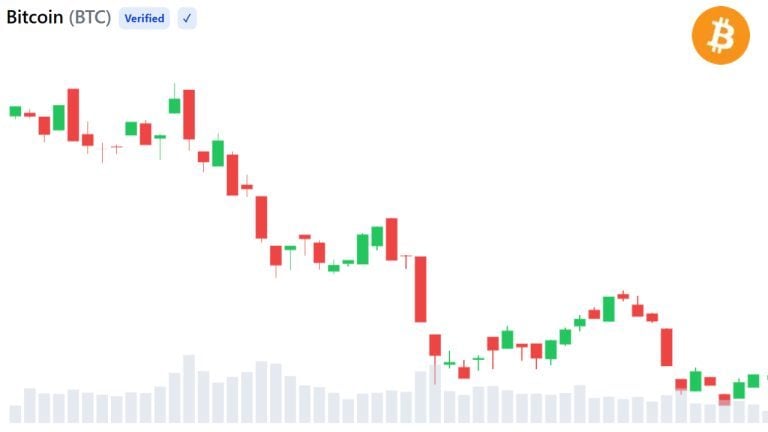


Macro-driven ETF inflows have lifted prices, but CryptoQuant data signals large holders are positioning to sell near a key breakeven zone

Macro-driven ETF inflows have lifted prices, but CryptoQuant data signals large holders are positioning to sell near a key breakeven zone

Whale accumulation tightens Bitcoin supply, potentially driving prices higher amid geopolitical tensions and macroeconomic volatility. The post Whales accumulate 270,000 Bitcoin in largest buy since 2013 appeared first on Crypto Briefing.


The post Bitcoin Eyes $78,000 Resistance—Will the BTC Price Rise Above the October Bearish Trend? appeared first on Coinpedia Fintech News Easing geopolitical tensions have strengthened bullish momentum, pushing Bitcoin price to test $76,000 for the first time in two months. At the same time, the Fear & Greed Index has climbed to a six-month high, signaling a shift in sentiment from fear toward neutral. As a result, BTC is now approaching a critical turning point, …


On-chain data shows altcoins like XRP and Solana are observing a higher amount of investor loss relative to their market caps than Bitcoin. XRP & Solana Are Observing A High Value On The Relative Unrealized Loss In a new post on X, on-chain analytics firm Glassnode has talked about how the Relative Unrealized Loss compares […]


Ethereum (ETH) price trades at $2,355, sitting directly on its 100-day Exponential Moving Average (EMA). A structural indicator says bulls are in control. Whale data and derivatives say otherwise. The two camps are split, and one single level separates their outcomes. A 2% move in one direction settles the argument. Smart Money Stays Bullish Inside The post Ethereum Price at $2,400 Settles a Fight Between Smart Money and Whales appeared first on BeInCrypto.


The post Lido DAO Price Outlook: Is LDO About to Outperform the Market? appeared first on Coinpedia Fintech News Lido DAO is breaking out at a time when traders are actively rotating into strength. A sharp 10% surge has pushed LDO out of its multi-week range, and the move is already attracting fresh demand across both price action and on-chain activity. Momentum is no longer building quietly; it is now visible, sustained, and gaining …


BitMEX Research has proposed a conditional “canary fund” that would only trigger a network-wide freeze of older Bitcoin wallets if a quantum computer is proven to have successfully stolen funds. BitMEX Research published the alternative strategy on Thursday, arguing that…


Lebanon's denial highlights internal political challenges, complicating peace efforts and increasing market uncertainty amid ongoing conflict. The post Lebanon denies knowledge of planned talks with Israel amid 2026 war appeared first on Crypto Briefing.
The post Top Reasons Why Crypto Prices Are Up Today? appeared first on Coinpedia Fintech News After 11 straight weeks of slow and sideways movement, the crypto market is finally showing signs of recovery. Today, the total market value has risen by about 1.5% to reach $2.54 trillion. Bitcoin is leading this move, jumping around 7% this week and trading near $75,063. Other major coins like Ethereum, Solana, XRP, Dogecoin, and …


Bitcoin's stability amid geopolitical tensions highlights its role as a hedge, influencing market confidence and risk assessment strategies. The post Bitcoin rally pauses near $75K amid US-Iran tensions, inflation hedge role appeared first on Crypto Briefing.


Iran's tolls on the Strait of Hormuz could escalate tensions, potentially prompting military responses and impacting global trade routes. The post Iran imposes tolls on Strait of Hormuz, UK warship transit odds rise appeared first on Crypto Briefing.

Switzerland Producer and Import Prices (MoM) meets forecasts (0.2%) in March

Switzerland Producer and Import Prices (YoY) remains at -2.7% in March

Here are the key points:

The UK Gross Domestic Product (GDP) grew 0.5% MoM in February, following a 0% reported in January, the latest data published by the Office for National Statistics (ONS) showed on Thursday.

United Kingdom Total Trade Balance down to £-0.72B in February from previous £3.922B

United Kingdom Index of Services (3M/3M) came in at 0.5%, above forecasts (0.3%) in February

United Kingdom Goods Trade Balance came in at £-18.791B, above expectations (£-20.2B) in February

As the cryptocurrency market gradually turns bullish, a notable growth is being observed across Ethereum’s price action and its staking ecosystem. After a series of staking activity among retail and institutional investors, the ETH staking market cap has exploded, reaching new levels. ETH Staking Market Cap Sees Explosive Growth The Ethereum ecosystem is undergoing a […]


The Bitcoin Policy Institute (BPI) has released a new policy proposal for the United States aimed at establishing what it calls “stablecoin supremacy.” The proposal, published on Wednesday, is structured around five policy areas and comes on the heels of the already-enacted GENIUS Act. Bitcoin Policy Institute Warning At the center of BPI’s argument is the claim that regulated stablecoins can help extend US oversight over offshore dollar markets. In the institute’s view, doing so would not only reduce systemic risks but also blunt what it frames as China’s push into digital currency. The BPI describes how offshore banks can create dollar-denominated credit on their own, capture the profits from intermediation, and rely on the Federal Reserve (Fed) as a kind of implicit backstop when the system strains. BPI characterizes this setup as a serious vulnerability for the US economy. Because of that, the institute argues that regulated stablecoins offer the United States a tool for restructuring the underlying dynamic. Related Reading: Bitcoin Price Breaks Higher: What The Market Data Says Could Happen Next Under the GENIUS Act, signed into law in July 2025, BPI says stablecoin issuers must maintain 100% reserves in instruments such as Treasury bills, Treasury repo, or insured deposits. The law also prohibits issuers from lending against those reserves. BPI says the result is that when a foreign individual or corporation holds a GENIUS-compliant stablecoin instead of placing funds in a Eurodollar deposit, the relevant Treasury security sits on the balance sheet of a US-regulated entity rather than feeding the offshore system’s ability to multiply credit. In BPI’s framing, the dollar value can move around the world, but the reserve stays “home,” reducing what it calls the external vulnerability dimension of the Triffin Dilemma. Stablecoin Supremacy Blueprint BPI further links the stablecoin case to broader competitive pressures in digital assets. It notes that China’s digital yuan now pays interest to holders and that China’s Cross-Border Interbank Payment System processes transactions across 190 countries. The institute also points to Europe’s MiCA regime, arguing it provides a framework for euro-denominated stablecoins that is, in some respects, more advanced than current US implementation. Taken together, BPI says these developments weaken American influence over the “rails” where money actually moves—an area BPI calls both the most contested and most fragile part of dollar dominance. To respond, the institute proposes a framework to advance stablecoin supremacy across five policy areas. First, it calls for hardening GENIUS Act implementation by building a backstop architecture. BPI describes this as creating committed repo lines with primary dealers and establishing a path to Federal Reserve Standing Repo Facility access, with the goal of making compliant stablecoins more attractive than offshore alternatives. Second, BPI proposes that the United States export stablecoins rather than Eurodollar deposits in international trade settlement. The aim, according to the institute, would be to pull Treasury demand back onshore and eliminate what it describes as the offshore credit multiplier on marginal dollar flows. Related Reading: What Presidio Bitcoin Found About Quantum Computing: Threat Timeline And Next Steps Third, BPI argues for a fee and rewards approach that allows regulated stablecoins to compete with interest-bearing Eurodollar deposits and even China’s digital yuan—while still staying within the GENIUS Act’s statutory interest prohibition. Fourth, the proposal addresses decentralized finance (DeFi) risks. BPI warns about DeFi credit multiplication and calls for smart-contract-level restrictions and enforcement “chokepoints” to ensure unregulated protocols cannot replicate the Eurodollar multiplier on blockchain networks. Finally, BPI says the US should preserve foreign currency sovereignty by supporting local monetary systems alongside stablecoin adoption. The institute frames this as a way to ensure stablecoin integration acts as shared economic development rather than financial coercion. In the institute’s view, these goals can be achieved without issuing additional sovereign debt to foreign governments or expanding the Federal Reserve’s balance sheet. Featured image from OpenArt, chart from TradingView.com
Load more news